
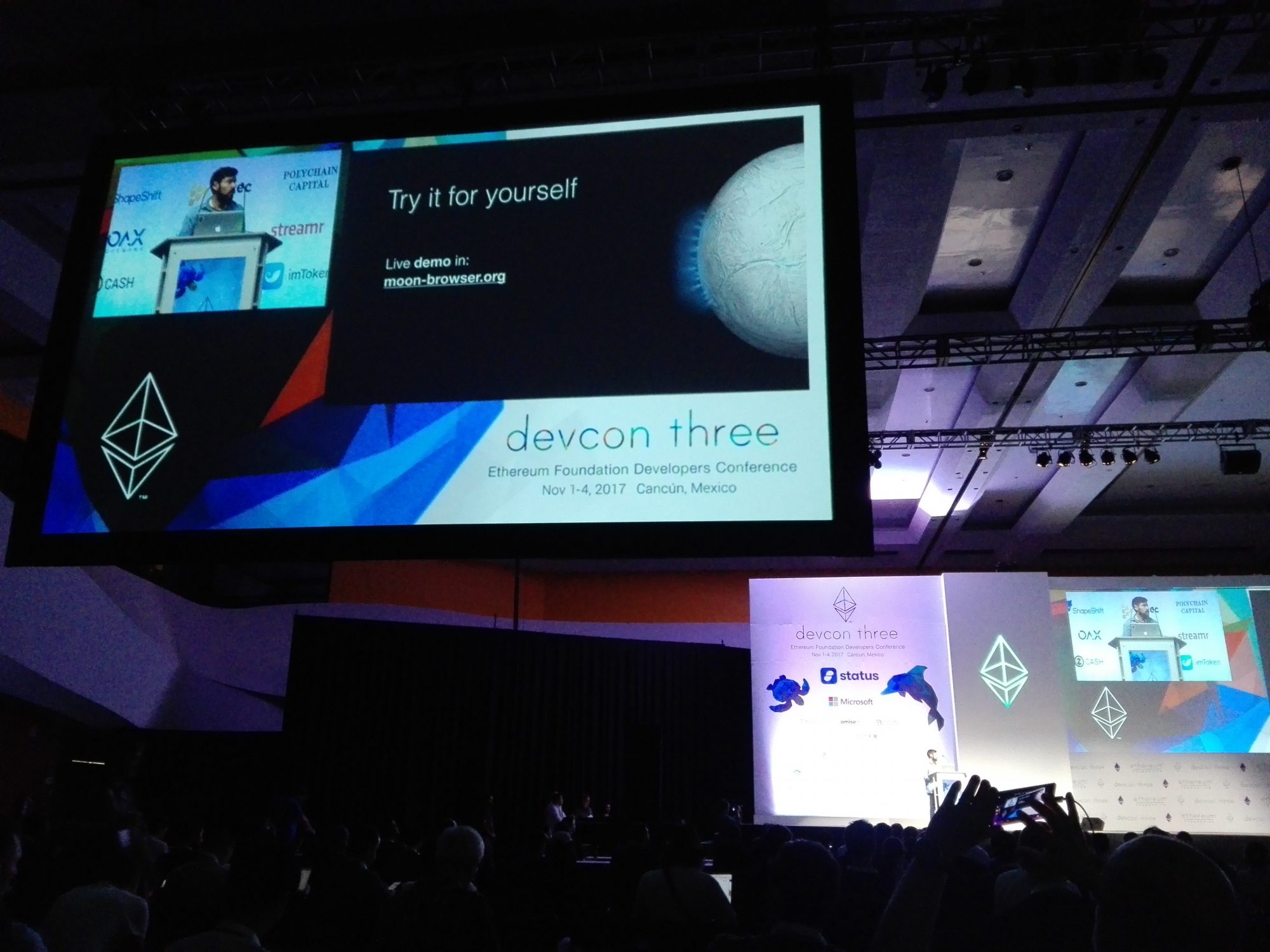
Victor Maia presenting Moon on the main stage.
In early November, Provenance took part in the fourth edition of the annual Ethereum development Conference (Devcon3) in Cancùn, Mexico. Let’s reflect on a week of invaluable learnings with the developer community.During the 4 days and 147 sessions of the biggest Devcon ever, it was hard to keep up with all the content and announcements. Here are some highlights that are particularly relevant to our values and mission to make supply chains transparent:Much signal, little noiseOne of the most striking observations we made at Devcon was about the quality of the conversations. Many will have recognised that noise increased substantially in the past year within the blockchain space, as a possibly necessary path to mainstream adoption of blockchain technology. Devcon was not about that. As every year, the conference was mostly about reasonable, “science-based” talks and conversations, as Cornell researcher Emin Gün Sirer put it. Very refreshing.Zero-knowledge proofsBehind this obscure term hides a possible solution to Ethereum’s privacy limitations. Often quoted as a flaw of public blockchains due to the data being accessible to anyone, privacy is being tackled using new cryptographic tools based on 30 year-old theory and adapted from other blockchains. In particular, a tool called ZoKrates was introduced as a way to let developers write simple code that is then turned into a privacy-preserving program. On top of that, such a construct can help scale public blockchains by reducing the resources needed on chain. In the context of supply chains, applications of these promising technologies could include the possibility for a business to prove that they receive goods from an organic certified business without disclosing exactly which one.Verifiable claimsThanks to work being done mostly to decentralise identity, verifiable claims are becoming a powerful concept. They are making it easy for anyone to claim that something is true, and for other parties to verify that claim. A typical application was explored in our recent pilot with the Soil Association. A variety of approaches are being used: uPort is building a smartphone app to manage anyone’s identity, enabling them to access applications as well as collect and issue badges to other users. Ethereum Foundation developer Fabian Vogelsteller is leading the creation of a standard on verifiable claims that would make different frameworks interoperate, just like some websites today enable to sign in using your favorite social media account. During our talk on the last day of the conference, we explained how we’re extending verifiable claims to businesses and products to create a backbone for trust in supply chains.These are just a small subset of what happened at Devcon3: from how to replace the wasteful and inefficient proof of work algorithm used in Ethereum, to how to increase security of smart contracts by proving them mathematically, to how to make charity donations more transparent, Devcon3 was a succession of fascinating talks. We can't wait for the next gathering!

Provenance powers sustainability claims you can trust. The global leader in sustainability marketing technology, Provenance helps brands and retailers share credible, compelling and fact-checked social and environmental impact information at the point of sale. Provenance’s technology is already increasing conversion rates, brand value and market share for customers including Cult Beauty, Douglas, GANNI, Napolina, Arla and Unilever
%20(1)%20(2).webp)